
On Saturday, we hosted a Book Lovers’ Celebration at Barnes & Noble in the Southmont Shopping Center (Bethlehem Township, Pa.)

The book business is hard, especially in the multimedia, quick-and-flashy universe we live in today. People can’t hide like they used to, and, whether you do good things or bad things, people will record and remember the things you do.
That’s why we have a mission here at Parisian Phoenix to, of course, publish books that have unique voices and diverse perspectives, but we also strive to build community, among our authors and creatives on the team; among writers, authors, and other creatives not on our team, and within the world at large.
In my decades as a print newspaper journalist, and many many decades as a writer overall, I have learned that treating people fairly, offering and giving trust, and welcoming others fosters honest and vulnerable interaction that allows people to grow stronger together.
I talked to a lot of people on Saturday and our intern, Allison, talked to a lot more. I talked to a designer there to buy a Bible. I talked to someone who used to work for an airline and wondered if there might be a market for travel stories from her perspective. I had people ask questions and share what they love about books.
How bookselling works
It’s hard to articulate the energy that goes into and comes out of an event like this at a national chain bookstore. For the author, it’s a sign that they have achieved something recognizable to their average family member, their boss, or a stranger. For me, as the publisher, it means we have to work hard to draw people into the bookstore and buy books, because the bookstore and purchased them with the expectation of selling them.
Well, that’s how a store works, you might say. Yes, that is true. But most (but not all) small, independent bookstores work on consignment. The author (or publisher) provides the books and the bookstore will place them on the shelf for a percentage of the retail price if sold (typically 40%). Some independent bookstores also charge a stocking fee (like $25 a title for example) to compensate them regardless of whether the book sells.
Events like book signings, talks and special events rely on several factors for success, but think of it more like karaoke in a bar. The owner or manager hires you or agrees to let you come in for a share of the at-the-door cover charge. You either make your money from the fee the owner paid or the portion of the cover charge. Either way, success depends on:
- Your fans coming to see you.
- How well you (and the owner/manager) publicize the event. (And remember you can’t control what the owner/manager does.)
- Your appeal to strangers. (In other words, if someone randomly walks into the bar, will you keep them there ordering drinks and food or will they leave?)
In book terms, in the traditional royalty model, a $20 book let’s say costs $5 to print. Publishers then set discounts for booksellers that normally span 40-50%. And if you work with Ingram and a small press using print-on-demand like I do, you may set the discount at 50% but Ingram might only offer 30 or 40 (which increases Ingram’s profits, not those of the publisher).
So Barnes and Noble should get the book for $10 a copy, if set at a 50% discount. If the print cost was $5, that leaves $5 for the publisher, but the publisher also needs to pay its staff and give royalties to the author.
If a bookseller sells a book on consignment, the author would buy the book and when it sells, the bookseller would keep $8. The author would get $12, but would have to subtract the original print costs of $5 yielding a $7 profit.
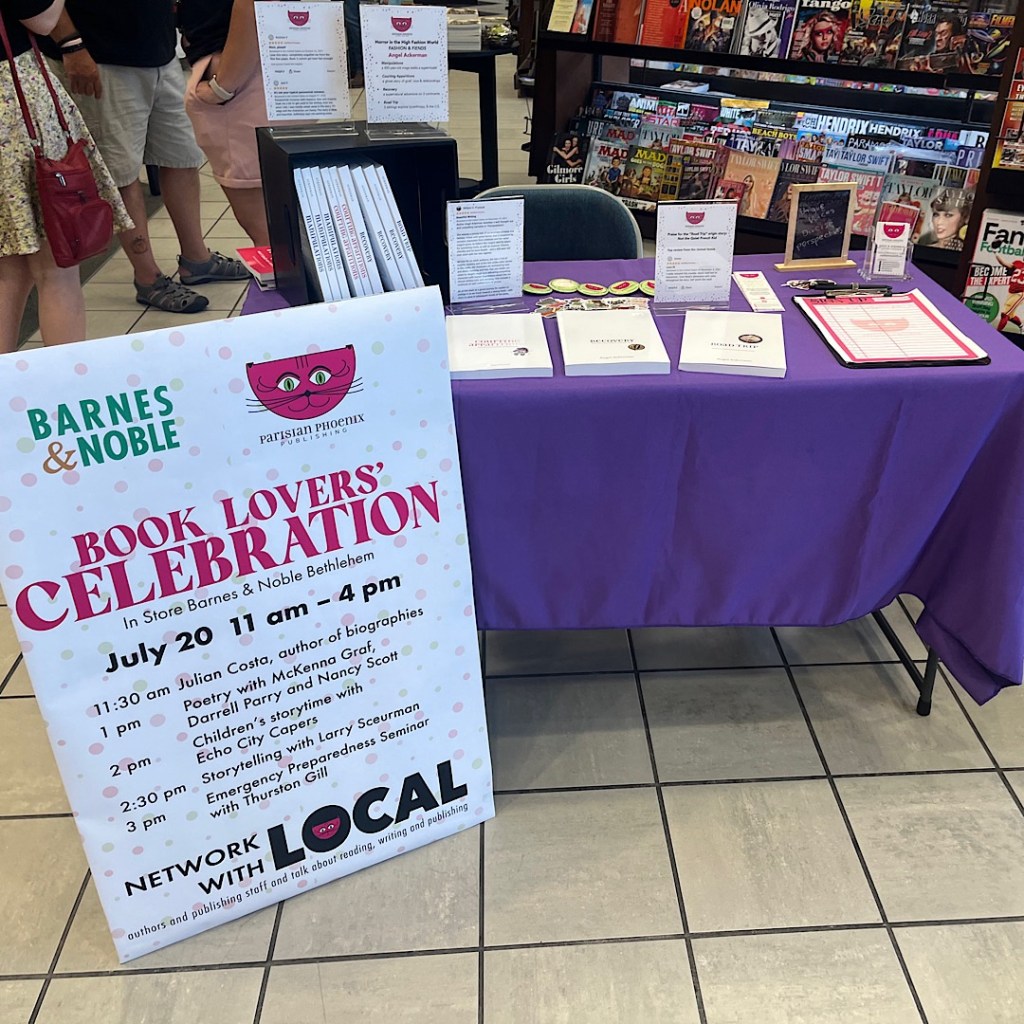
Our event Saturday
We made posters and social media posts and collaborated with the store on some shared social media. I checked in with the store regularly, and in hindsight there were some things I could have down with my team to improve the day.
The first event of the day was Julian Costa‘s talk on research and preserving local/niche history. Our art director Gayle Hendricks also had the chance to show off her design styles.
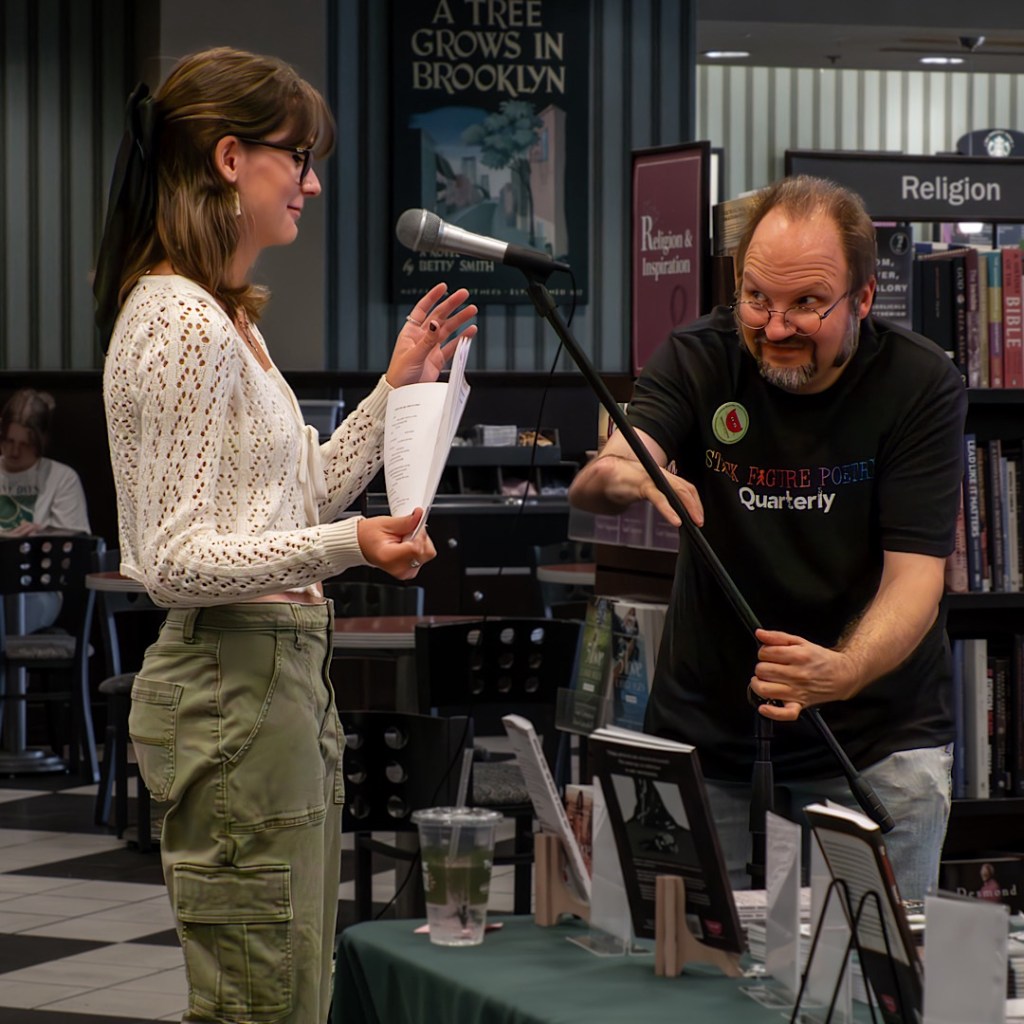
At 1 p.m., we had a poetry reading with Darrell Parry, McKenna Graf and Nancy Scott. Barnes has copies of Darrell’s book Twists: Gathered Ephemera and they also picked up McKenna’s Mortals, Myths and Maybes. Give us a few days and we may have some video highlights to share.
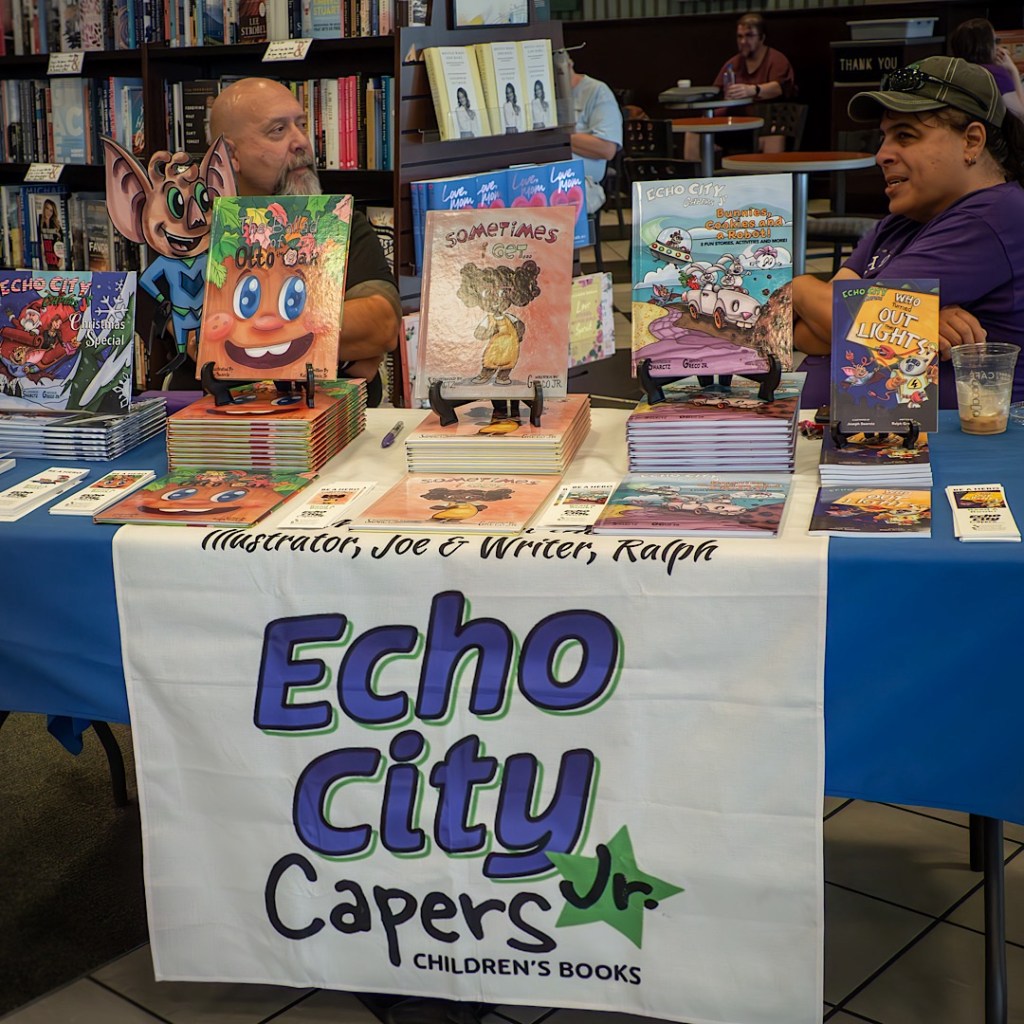
At 2 p.m., Ralph Greco read from two of the Echo City Capers books in stock at Barnes, The Ballad of Otto the Oak and an excerpt from the middle grade chapter book, Who Turned out the Lights?
At 2:30 p.m., Larry Sceurman told some stories from his short story collection, Coffee in the Morning, also in stock at Barnes.
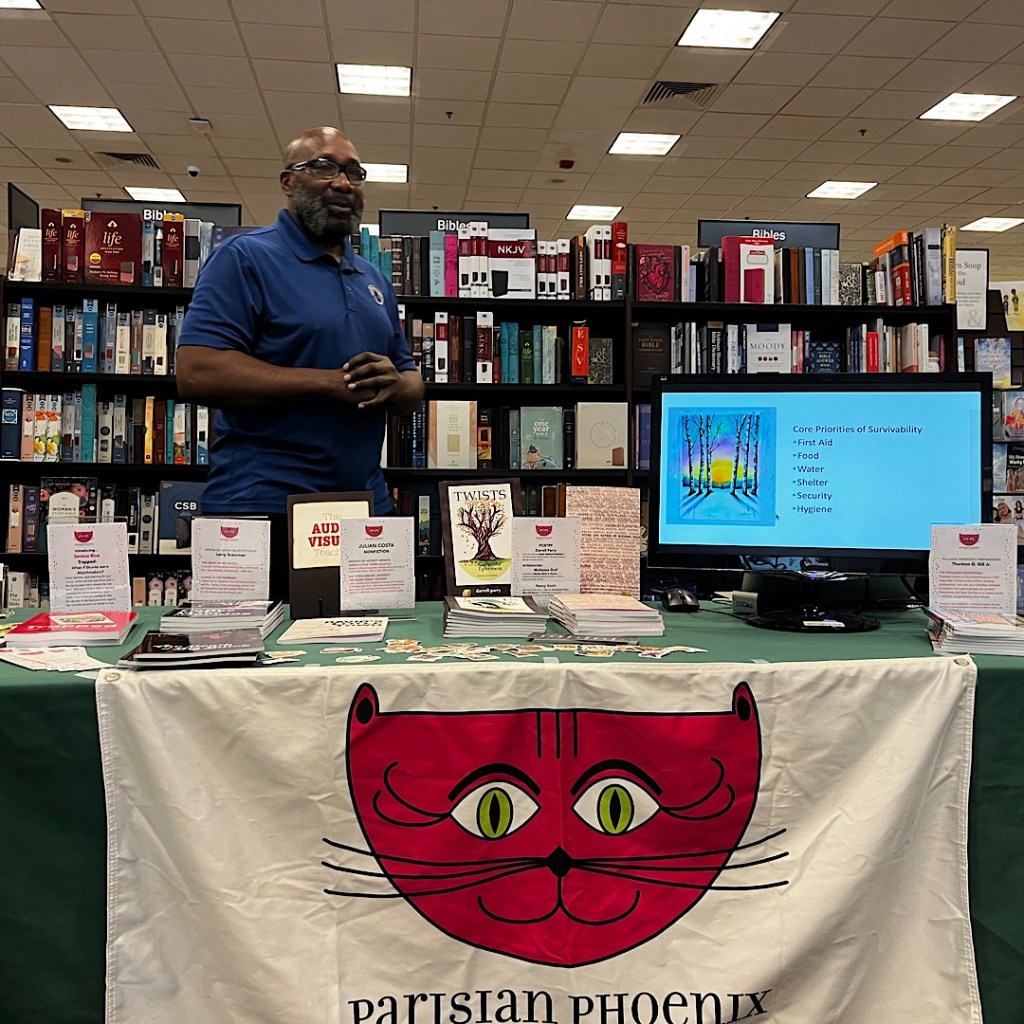
At 3 p.m., Thurston Gill hosted an emergency preparedness seminar. His book, The Phulasso Devotional, is also in stock at the Bethlehem Barnes.
See more photos by clicking here. Also, somehow, we managed to go the whole day without getting a good photo of Larry Sceurman. He’s the only one truly missing in our photos, and I would say that Allison is missing, but if you look hard enough you can find her in the background of some shots.




 Parisian Phoenix Publishing
Leave a comment